Inkosi finishes as Nigeria’s best at 24th African Fencing Champs

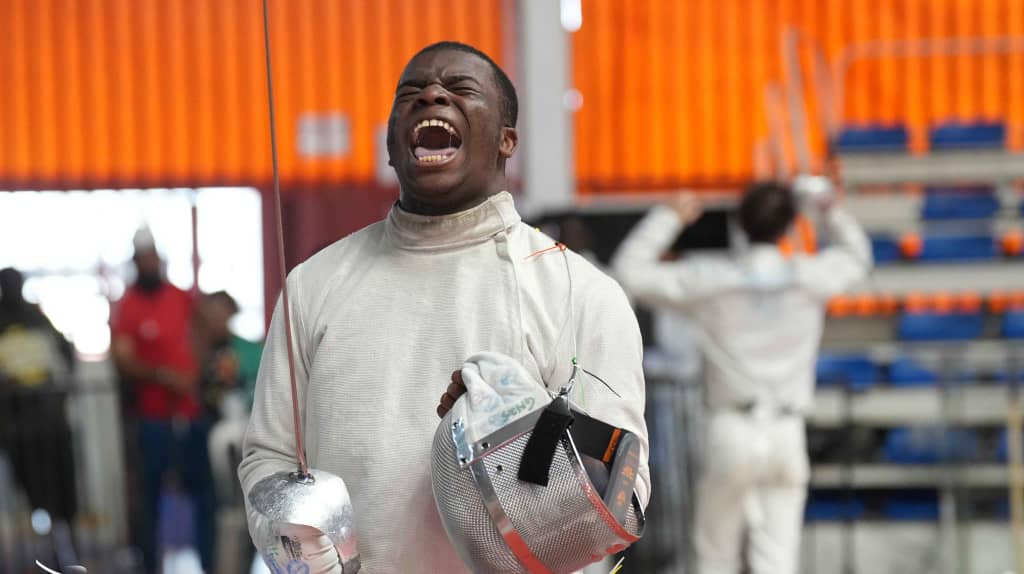
Nigeria’s fencing sensation Brou Inkosi emerged as the country’s best performer at the 24th African Fencing Championships in Abidjan, Côte d’Ivoire on Saturday, finishing seventh in the men’s sabre event.
Inkosi competed alongside compatriots Oluwafolayemi Akinyosoye and Phoenix Olen, facing a tough field that included 2024 Olympic silver medalist Fares Ferjani of Tunisia and defending champion Ahmed Hesham of Egypt.
Hesham went on to secure back-to-back titles, adding Abidjan to his Lagos 2025 triumph.
Starting in Pool 1 with Hesham, Inkosi lost narrowly to Hesham (1-5) and Libya’s Mohamed Abujnah (4-5), but bounced back with victories over opponents from Cape Verde, Algeria, Senegal, and Côte d’Ivoire.
His strong group-stage performance earned him a bye into the round of 16, where he edged Algeria’s Lotfi Ibrihen 15-14 in a tense contest.
In the quarterfinals, Inkosi once again faced Hesham. Displaying courage and tactical brilliance, the 18-year-old unsettled the Egyptian with clever moves that exposed the top seed at times.
However, Hesham’s experience proved decisive as he won 15-9 en route to retaining his crown.
Despite being seeded eighth, Inkosi finished seventh overall — ahead of several seasoned athletes.
Like Inkosi, Akinyosoye also advanced from the group stage, winning two matches and losing three. Beginning his knockout run in the round of 32, he defeated Côte d’Ivoire’s Emmanuel Kouadio 15-11 before falling to Ferjani 15-7 in the round of 16. He placed 13th among 27 sabre fencers.
In the men’s epee, Diekolola Johnson and Leonard Chizim Aninyei progressed from the group stage but exited in the round of 32, losing to opponents from Cape Verde and South Africa.
Their advancement marked an improvement from Lagos 2025, where they failed to progress beyond the groups.
Read Also: Tottenham complete double free agent signing
In the women’s epee, Adebodunrin Thomas advanced from the group stage but was edged out 15-12 by Egypt’s Loulwa Soliman in the round of 32. Kenya’s Alexandra Ndolo retained her title in the event.
National coach Ibrahim Alogba praised the team’s performance, describing it as valuable preparation for the upcoming 2026 Commonwealth Championships in Lagos.
“I must commend the fencers for their display because they all gave their best against the best.
This is good for their confidence going into the Commonwealth Championships, and we hope some of them can still compete globally before the tournament in Lagos from August 9 to 14,” Alogba said.
Fencing is a combat sport that features sword fighting. It consists of three primary disciplines: foil, épée, and sabre (also spelled saber), each with its own blade and set of rules.
Most competitive fencers specialise in one of these disciplines. The modern sport gained prominence near the end of the 19th century, evolving from historical European swordsmanship.
Scoring points in a fencing competition is done by making contact with the opponent with one’s sword.
Fencing is governed by the Fédération Internationale d’Escrime (FIE), headquartered in Lausanne, Switzerland.
The FIE is composed of 155 national federations, each of which is recognised by its state Olympic Committee as the sole representative of Olympic-style fencing in that country.
In fencing, each bout (i.e. a match between two individuals or teams) is decided by either reaching a set number of hits or outscoring the opponent within a specified time limit, depending on the format of the competition.